
Sex Offender Checks in Montgomery County
The official Arkansas registry is the main public channel for Montgomery County. It is part of the Arkansas Sex Offender Notification System and is managed by ACIC under the Department of Public Safety. Search the state portal for public records, then contact the sheriff when the question concerns local registration procedure, verification, or compliance reporting.
The public registry is not a full list of every person who has any sex-offense history. Arkansas publication rules turn on risk level and statutory conditions. Searchers should also match more than a name because common names, aliases, and moves can create confusion. Check the profile date, status, jurisdiction, and address display together. When the result does not resolve a safety question, ask the sheriff or ACIC about the official record rather than relying on a copied listing.
Montgomery County Address and Name Searches
Place-based searching is useful in a county with several small communities. The research identifies Mount Ida, Norman, and Oden as local city choices, with ZIP examples including 71957, 71960, 71961, and 71966. Use the current official portal controls rather than assuming that a city label captures all nearby rural addresses.
A name search is better when a specific identity is known. An address, county, ZIP, or radius search is better for community awareness around a place. In either route, open the full profile and compare aliases, physical description, registration status, and jurisdiction before drawing a conclusion.
County and ZIP boundaries do not always describe the same area, and a mailing city can differ from the law-enforcement jurisdiction that holds the registration. Try more than one place search when checking an address near a town or county line. Record the date of the search because residence and compliance status can change. If a profile appears to contain an error, send the question to the registering office or ACIC instead of repeating the disputed detail.
How to Search the Arkansas Sex Offender Registry
The Arkansas Sex Offender Registry is the state source for public profiles. The interface may change, but the researched field set supports a direct search workflow.
- Open the official registry and review its conditions of use.
- Search by name, or choose a place filter such as city, county, ZIP, address, or radius when offered.
- Select Montgomery County or enter the relevant local place, then submit the search.
- Open a result and compare the full profile, risk level, status, address display, and registering jurisdiction.
| Field | Type | Required | Use |
|---|---|---|---|
| Name | Text | Optional | Search by registrant name or alias. |
| Address or location | Text or map | Optional | Find public results around a place. |
| City | Text or dropdown | Optional | Use a local city when available. |
| County | Dropdown | Optional | Select Montgomery. |
| ZIP | Text | Optional | Narrow a place search. |
| Radius | Dropdown | Optional | Use the portal's current distance choices. |
| Search | Button | Yes | Submits the chosen criteria. |
Recognizing the Arkansas Registry Portal
The registry's official search screen is the correct starting point for an Arkansas profile. After opening the state registry search, the image below helps distinguish the government portal from commercial results.
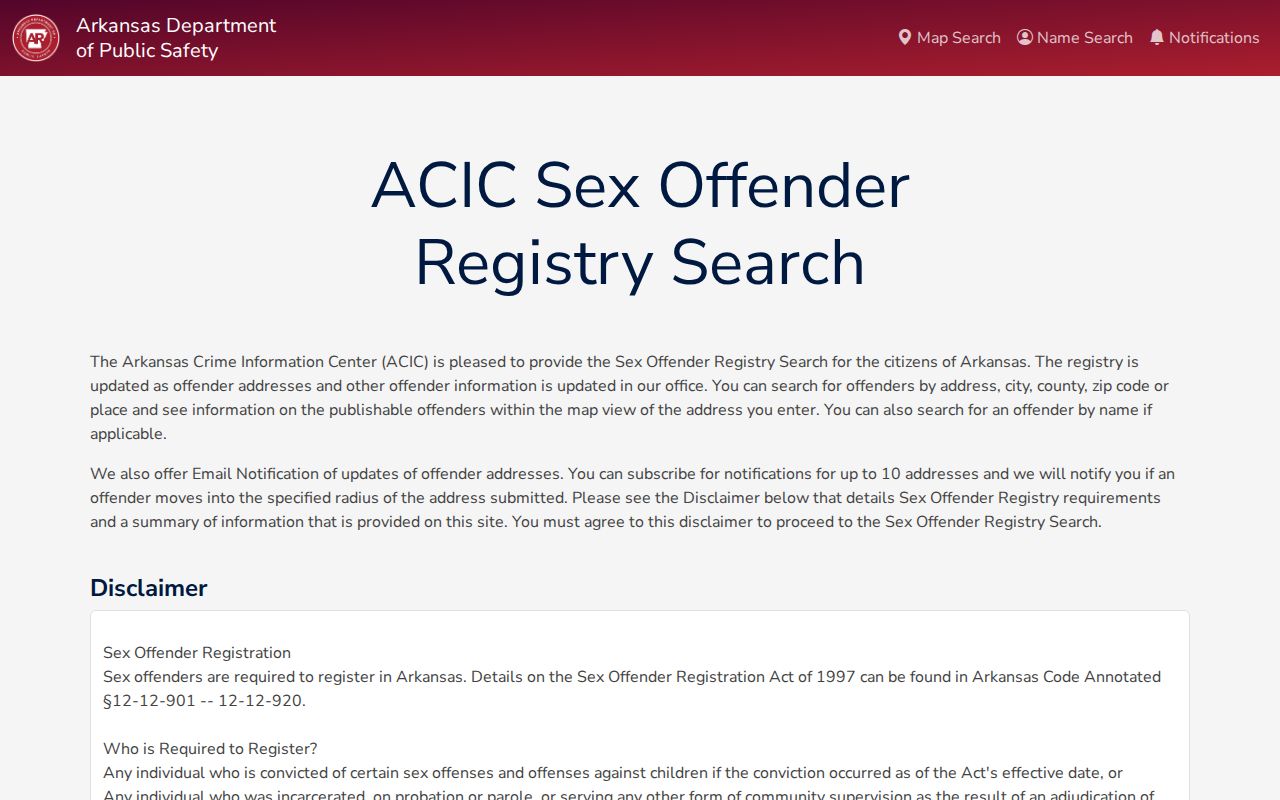
Use the live portal for current information. A captured screen is only an orientation aid and cannot show later moves, compliance updates, or changes to public display.
Inside a Montgomery County Registry Profile
A public profile combines identity, assessment, offense, and registration information. Review the complete record rather than relying on the result card or a map marker.
| Name and aliases | Public identity names used to match the correct profile. |
|---|---|
| Photo and description | Photo if public, plus sex, race, height, weight, hair, eyes, and displayed age information. |
| Risk level | Arkansas assessment level and its public meaning. |
| Status | Registration or compliance status as displayed. |
| Address | Residence or block-level location shown by the portal. |
| Offense | Offense description or statute and conviction date when displayed. |
| Other fields | Employer, school, vehicle, marks, scars, or tattoos if the Arkansas profile publishes them. |
| Jurisdiction | The registering or supervising law-enforcement office. |
Sensitive identifiers, protected juvenile information, and nonpublic low-risk data are not ordinary public profile fields. Do not try to infer withheld details.
Why Some Montgomery County Level 2 Records Appear
ACIC says Level 3 and Level 4 information must be available on the state website. It also says a law change added public access for some Level 2 offenders who were at least 18 and whose victim was 14 or younger at the time of the offense. That means Level 2 publication is not described as universal.
Level 1 is labeled low risk and is not described in the captured ACIC text as a category that must be posted publicly. A public search result set therefore reflects publication law, not a complete roll of all registration records held by law enforcement.
Arkansas Registration Levels and Requirements
Arkansas uses four assessed risk levels. The research did not establish a universal public duration or verification schedule for each level, so those details should be confirmed with the sheriff for a specific registration duty rather than invented.
| Level | ACIC description | Public visibility |
|---|---|---|
| Level 1 | Low Risk | Not described as mandatory state-web posting in the captured rule. |
| Level 2 | Moderate Risk | Some profiles are public when statutory conditions apply. |
| Level 3 | High Risk | Must be available on the Arkansas website. |
| Level 4 | Sexually Violent Predator | Must be available on the Arkansas website. |
ACIC also says a person who fails to submit to assessment is assigned default Risk Level 3. Risk level is an assessment category, not a cue for private punishment.
Registering in Montgomery County
Arkansas Code §§ 12-12-901 through 12-12-920 govern the system described by ACIC. A person moving to or returning to Arkansas must register with the local law-enforcement agency that has jurisdiction within three business days of establishing residence. Failure to register, report an address change, or comply with assessment is a Class C felony.
Montgomery County Sheriff's Office
225 Fairgrounds Road
Mount Ida, AR 71957
(870) 867-3151
Call for appointment rules, the local verification schedule, registration procedure, or the proper way to report possible noncompliance.
ACIC's statewide registry manager contact in the research is Paula Stitz at 501-682-2222, 322 South Main Street, Suite 615, Little Rock. The sheriff is the local procedural contact; ACIC manages the statewide registry layer.
NSOPW and Montgomery County Border Searches
The National Sex Offender Public Website searches participating jurisdictions across state lines. It is useful when a person may have moved or when the area of concern extends beyond Arkansas. For Arkansas-specific risk levels, local registration, and the state's current public profile, return to ACIC.
The NSOPW federal search is shown below as the cross-state layer.
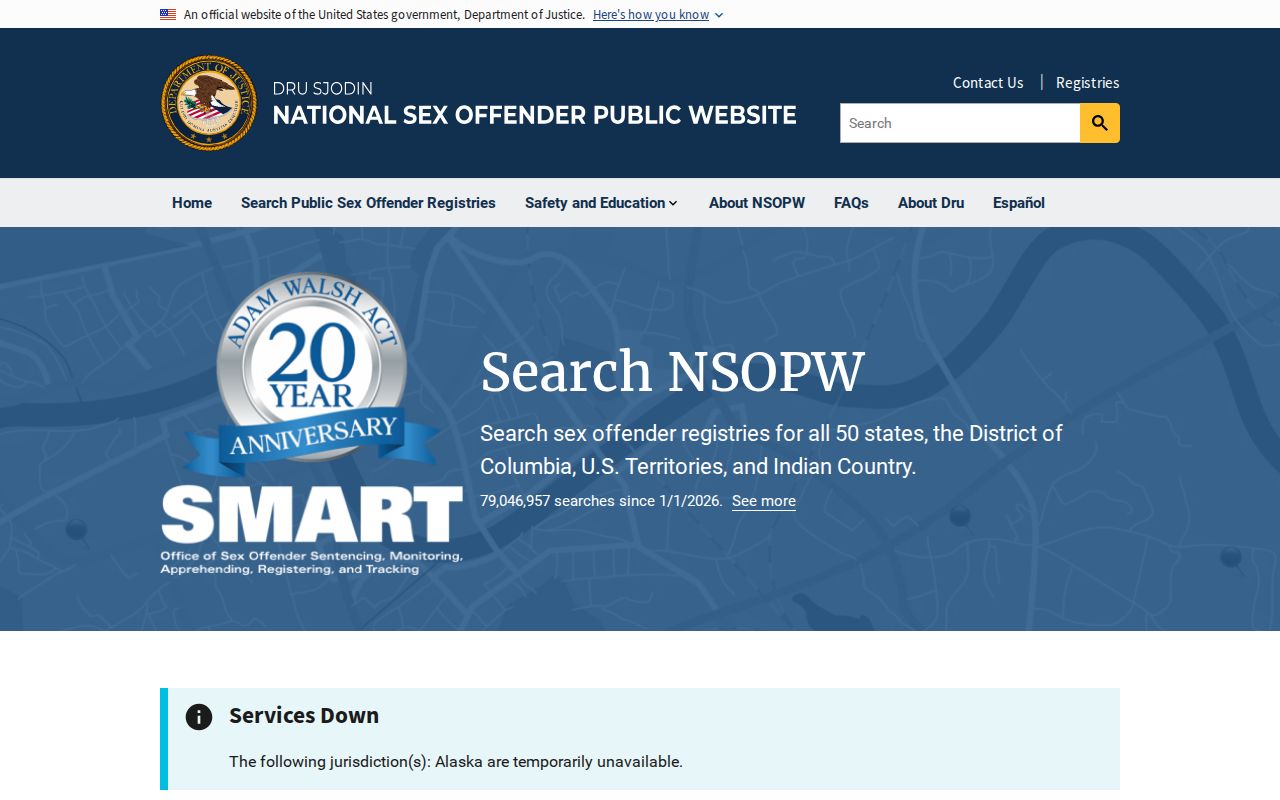
Differences between national and state results can arise from jurisdiction participation, update timing, search criteria, or state publication rules. Verify an Arkansas result through the Arkansas portal.
Community Notification and Lawful Use
Registry information supports awareness and safety planning. It should be read with current context, and any immediate safety concern or suspected noncompliance should go to law enforcement. Do not confront a person based on a web result.
Use registry information lawfully: Arkansas registration law is codified at Ark. Code §§ 12-12-901 through 12-12-920. Harassment, threats, intimidation, or vigilantism based on registry data is misuse, and unauthorized use of criminal-history information or denial of a civil right may be a Class A misdemeanor.
Confirm identity and status through the official profile, respect protected household members and neighbors, and report a suspected error to the sheriff or ACIC. Public access does not authorize retaliation.